This guide is the map for the whole topic: what the machine is and is not, what each axis configuration unlocks, how the template-free workflow runs from drawing to finished spindle, and how loading automation changes the throughput math. Where a subtopic deserves its own deep dive, the links point to it, so treat this page as the hub and branch out where your questions lead.
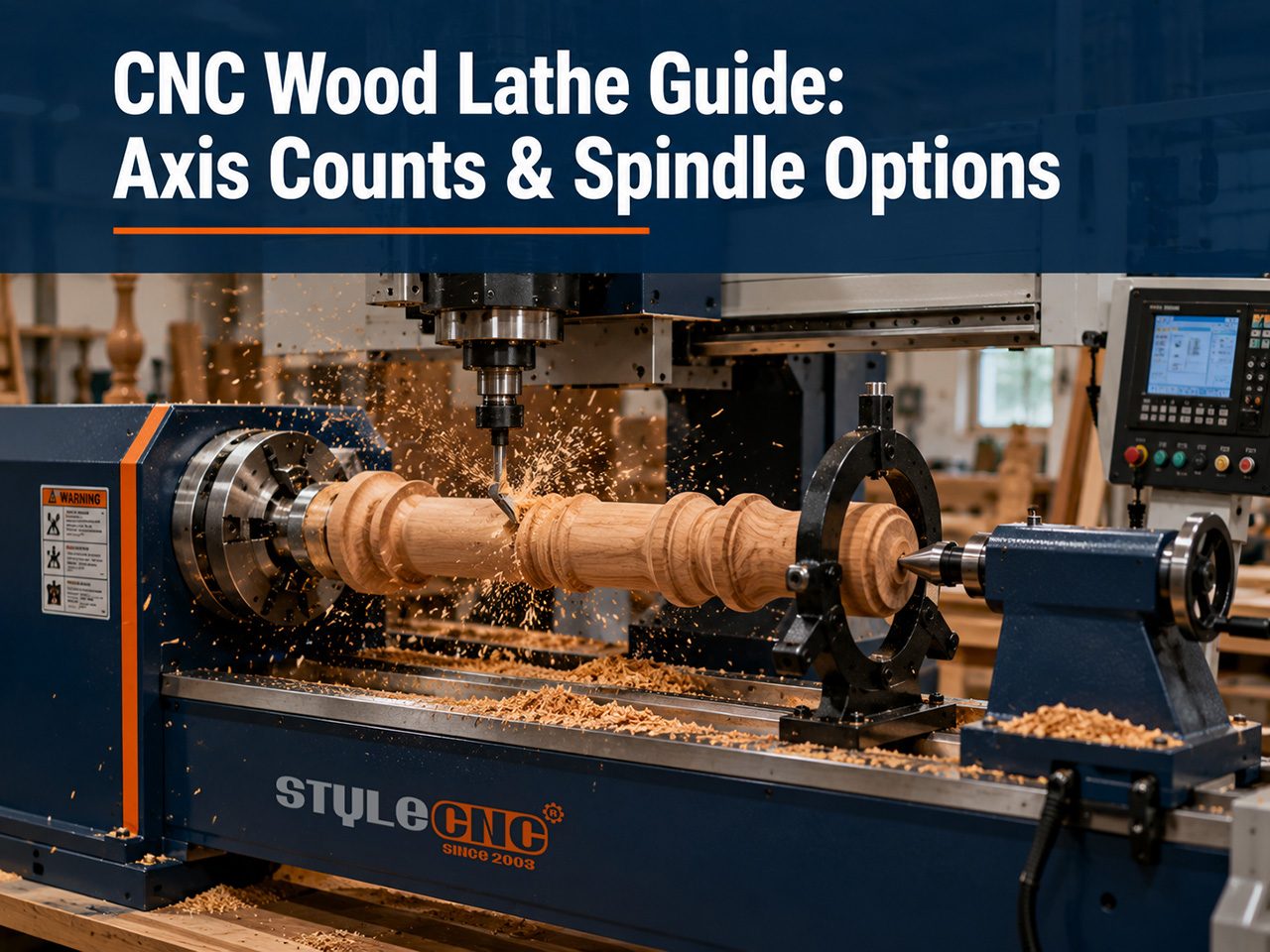
What Separates a CNC Wood Lathe from a Manual Lathe and a Bộ định tuyến CNC
A manual lathe spins the stock while a turner shapes it by hand, and every part carries the turner's skill and the day's consistency. A CNC wood lathe spins the stock the same way but moves the cutter along a programmed path, so the 5 hundredth baluster matches the 1st without a template or a practiced hand.
The router comparison trips up more buyers. A Bộ định tuyến CNC with a rotary 4th axis can carve a turned shape, but it removes material with a small router bit in many passes, which is slow for round profiles. A lathe removes material with a turning blade in one continuous cut, which is why a leg that takes a rotary router setup twenty minutes comes off a lathe in one or two.
Buyers usually frame it in their own terms: can this machine make forty matching table legs before lunch, or do I still need a turner on staff for the curved work? Both questions get answered by the axis section below, and the broader family tree is covered in wood lathe machine types explained for anyone comparing lathe styles side by side.
Axis Configurations and What Each Unlocks
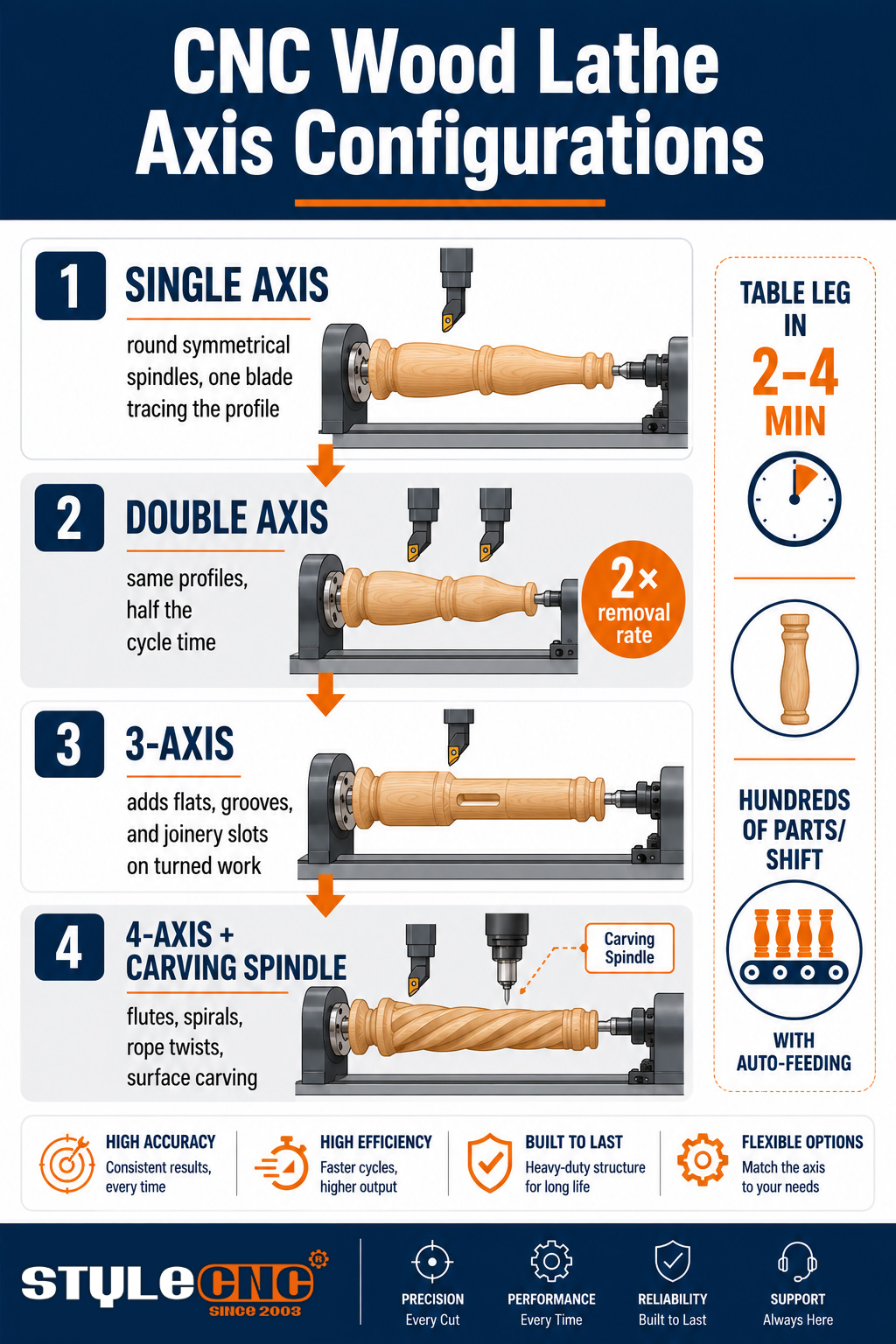
Axis count on a wood lathe describes how many independent motions the controller commands, and each step up unlocks new part geometry:
| Cấu hình | Những gì nó thêm vào | Part Geometries Unlocked | Sử dụng điển hình | Số đo của tôi |
|---|---|---|---|---|
| Trục đơn | One tool carriage tracing the profile | Round symmetrical spindles: legs, balusters, posts | Entry production turning | Parts per hour on your longest spindle |
| Double axis | 2 blades cutting simultaneously | Same profiles at roughly double the removal rate | Volume spindle work | Cycle time per leg against single axis |
| 3 trục | Independent tool paths beyond the trace | Slotting, flats, and grooves on turned work | Mixed turning and joinery prep | Setups eliminated per part |
| 4-axis with carving spindle | Rotary axis plus a router spindle | Flutes, spirals, rope twists, surface carving on the round | Decorative and custom work | Share of your catalog needing carved detail |
The 4-axis machine deserves the extra sentence it always gets, because the carving spindle changes the machine's category. With the rotary axis indexing the workpiece and a router spindle cutting along it, the machine produces rope twists, spiral flutes, and carved reliefs that previously required a specialist. Shops choosing between configurations can work through the trade-offs in the guide to buying the right CNC wood lathe, which pairs each configuration with the product catalogs it suits.
The Template-Free Workflow: Drawing to Finished Spindle
The workflow starts in software rather than at the machine. The operator draws or imports the half-profile of the part, a simple 2D outline of one side of the finished spindle. The CAM layer converts that outline into tool paths, calculating roughing passes that hog the square blank round and finishing passes that trace the final curve.
At the machine, the cycle is load, clamp, run. The blank spins up, the roughing blade squares it to round in seconds, and the profile blade follows the programmed curve end to end. A part change is a file change: no templates to cut, no follower to adjust, no setup beyond matching the blank length. That is the practical meaning of template-free, and it is why short custom runs became economical on these machines.
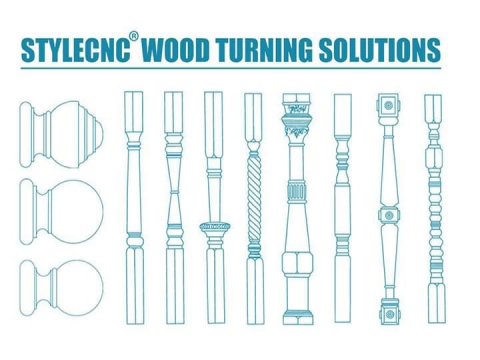
Most controllers accept common CAD formats and generate the turning program internally, so operators work with profiles and parameters rather than raw G-code. The finished results across furniture legs, balusters, bats, and columns are easiest to judge visually in the CNC wood turning lathe project gallery, which pairs each part style with the machine work behind it.
Spindles, Cutters, and Workholding
Turning, slotting, and carving tools
The turning blade does the fundamental work: a fixed profile cutter that shears wood as the stock spins. Slotting cutters add flats and grooves for joinery. The carving spindle is a separate high-speed router motor carrying standard bits, and it engages when the design calls for surface detail the turning blade cannot reach.
Holding long stock and short work
Spindle work clamps between a drive chuck and a tailstock center, with a steady rest supporting long thin stock against deflection; without it, a slender baluster whips at speed and the profile ripples. Bowl and short work reverses the logic, mounting on a faceplate or chuck at the headstock alone. Most production wood lathes are built spindle-first, and dedicated bowl capacity is the spec to confirm rather than assume.
Automatic Loading and Throughput
Loading automation is the multiplier on everything above. A manual-load machine still needs an operator present for every cycle; an auto-feeding magazine loads blanks, clamps, turns, and ejects unattended for as long as the magazine holds stock.
The throughput picture by machine class:
• Single axis, manual load: a table leg every 2 to 4 minutes with an operator at the machine.
• Double axis: the same leg in roughly half the cycle, since 2 blades cut simultaneously.
• Auto-feeding double axis: hundreds of parts per shift with one operator tending several machines.
• 4-axis with carving: cycle time depends on carving density, but the part comes off finished instead of visiting a 2nd machine.
The automation decision is labor math, the same as every machine purchase: an auto-feeder pays for itself when the operator it frees produces more value elsewhere in the shop. Owner experiences across volumes are collected in the wood lathe customer reviews, and they are candid about where automation earned its cost and where it idled.
Common Mistakes When Choosing a CNC Wood Lathe
• Buying a rotary-axis router for production turning and discovering the cycle times are unworkable.
• Sizing the bed to today's longest part with no allowance for the stair post order that arrives next year.
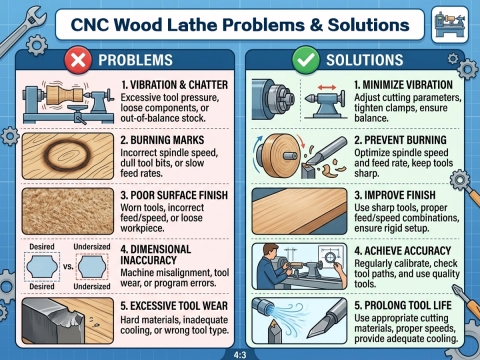
• Skipping the steady rest and blaming the machine for chatter on slender work.
• Paying for a carving spindle a catalog of plain round legs will never use.
• Ignoring dust extraction, then burying the guideways in shavings by the 1st afternoon.
Shortlist Checklist
• List your real part mix: lengths, maximum diameters, and how many need carved detail.
Match axis count to that mix, not to the most capable machine on the page.
• Confirm maximum stock length and swing diameter with margin over your largest part.
• Decide on auto-feeding from your labor math, not the demo video.
• Verify software workflow with your CAD files before the machine ships.
Câu Hỏi Thường Gặp
Do I still need turning skill to run a CNC wood lathe?
Not turning skill in the hand-gouge sense, but process skill matters: choosing feeds, supporting slender stock, and reading the cut. A good operator learns the machine in days, while hand turning takes years to master.
CNC wood lathe or Bộ định tuyến CNC with a rotary axis for table legs?
For round profiles in quantity, the lathe wins decisively on cycle time because a turning blade cuts continuously while a router bit nibbles. The rotary router earns its place when parts are mostly carved rather than mostly turned.
What does the 2nd axis on a double axis machine actually do?
It carries a 2nd cutting blade, so roughing and profiling happen together or 2 profiles cut at once. The practical result is close to double the removal rate on the same spindle work.
Can these machines cut flutes and spirals, or only round profiles?
Round profiles come from the turning blades; flutes, spirals, and rope twists need the carving spindle on a 4-axis machine, which indexes the workpiece while a router bit cuts along it.
What software runs a CNC wood lathe, and do I need to learn G-code?
Machines ship with turning software that converts a drawn half-profile into the program, and most operators never touch raw G-code. If you can draw or import the part outline, you can run the machine.
How fast is a CNC lathe against a skilled hand turner?
A practiced turner might shape a plain leg in ten minutes; a single axis CNC does it in 2 to four, a double axis faster still, and neither slows down after lunch. Consistency across the batch is the bigger gap than raw speed.
Can a CNC wood lathe turn bowls, or is it spindle-only?
Production models are built spindle-first, between centers. Some accept faceplate work within a limited swing, but if bowls are the business, confirm bowl capacity explicitly rather than assuming the lathe name covers it.
What stock sizes can these machines handle?
Common production beds handle stock up to around 1.5 to 2.5 meters between centers with maximum turning diameters near 300 to 400 mm, and long-bed variants stretch further for posts and columns. Match the spec to your longest recurring part with margin.
Is auto-feeding worth it for a small shop?
Only when the machine runs enough hours for the freed operator to matter. A shop turning a few dozen parts a day rarely recovers the cost; a shop feeding a furniture line almost always does.
Which woods run best on a CNC wood lathe?
Straight-grained hardwoods like beech, maple, birch, and oak cut cleanest and hold detail. Soft, stringy, or knotty stock tears and chatters, on CNC machines exactly as it does by hand, so blank quality still decides finish quality.
Compare Configurations Side by Side
See how single, double, and 4-axis machines line up across the full range of CNC wood lathes for turning and carving, with specifications, videos, and a free quote matched to your part list.